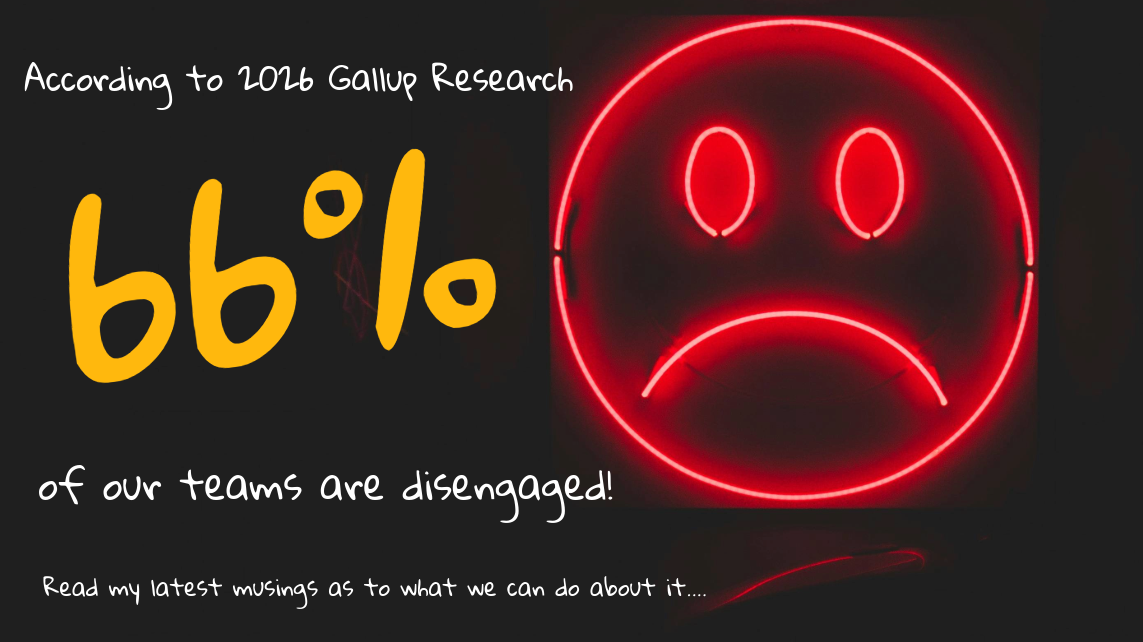
People riots don't always start with a dramatic event.
More often, they start with two thirds of your workforce quietly deciding they're going to do what's asked of them - and nothing more. No initiative. No discretionary effort. No ownership of the outcome. Just the bare minimum required to stay not get fired, while their energy, creativity, and loyalty go elsewhere.
That's not a people problem. That's a leadership environment problem. And the 2026 Gallup State of the Global Workplace Report has just handed Australian leaders the data to prove it.
The Australia & NZ numbers and the gap that matters most.
Here's where Australia and New Zealand sits right now on employee engagement:
21% of workers are engaged - present, committed, and giving their best.
66% are not engaged - showing up, but switched off.
13% are actively disengaged - checked out, and often making it harder for everyone around them.
That middle number is the one I want to talk about.
Sixty-six percent. Two thirds of our workforce is going through the motions. They're not bad employees. They're not about to resign (necessarily). They're just not emotionally connected to their work, their team, or the organisation they're in.
And that disconnection is expensive, in lost productivity, in the quality of decisions made, in the lack of innovation and in the culture that quietly forms when nobody's paying attention.
The manager advantage and what it means.
Here's the piece of the ANZ data that gives me genuine hope, and also genuine urgency.
Unlike the global picture, where manager engagement has collapsed by nine points since 2022 and managers have lost their engagement advantage over the people they lead, in Australia and New Zealand, managers are still ahead.
ANZ managers: 27% engaged.
ANZ individual contributors: 17% engaged.
That ten-point gap matters. It means we still have managers who are switched on, who care, who are investing themselves in the work. We haven't lost them …YET. Unlike many of our global peers.
But here's the thing about a 27% manager engagement rate. It means 73% of the people leading your teams are not fully engaged themselves. They may be functioning. They may be competent. But they are not in the kind of headspace that produces the conversations, the consistency, and the genuine human connection that shifts a team from 'not engaged' to actually invested.
The leverage point.
ANZ managers are still ten points more engaged than the people they lead - 27% versus 17%. That gap is the leverage point. Gallup's research has been consistent across the decades and shows that the direct line manager drives 70% of the variance in team engagement. Not strategy. Not benefits packages. Not the size of the office or the quality of the coffee. The relationship between a person and their immediate leader.
This is great news. It means the 66% of employees who are coasting in Australian workplaces right now are not an inevitability. They are an opportunity. They're waiting to be reached by someone who knows how to show up for them. Their direct line manager or leader.
Engagement doesn't happen at the organisational level. It happens in a conversation between a person and their leader, on an ordinary day.
More conversations, more often, with real intention.
This is where I see Australian organisations fall down, repeatedly. The engagement survey or pulse check, comes back with an average score. A new initiative gets launched. A workshop runs. And then everyone goes back to business as usual, with the same patterns of communication, or lack of it, that produced the average score in the first place.
Moving someone from 'not engaged' to ‘engaged’ isn't a program. It's a practice. It's the manager who checks in regularly, not just about the work, but about how the person is experiencing the work. Who notices when something's shifted. Who creates the space and safety that the real conversation can happen before the frustration becomes a grievance, or the disengagement becomes a resignation.
More conversations, more often. Not deeper, not harder - just more consistent, more human, and more genuinely curious about what's actually going on for the people doing the work.
The window is still open.
Australia and New Zealand hasn't hit the manager engagement crisis that's unfolding globally. Our managers are still more engaged than their teams. That's the advantage. The question is whether we're going to use it.
Because if we don't invest in building the capability of those managers to actually reach the 66%, to create the kind of environment where people feel seen, supported, and genuinely capable of doing their best work, that global trend will find us. It's only a matter of time.
The data tells us where the gap is. The work is closing it, one meaningful conversation at a time.