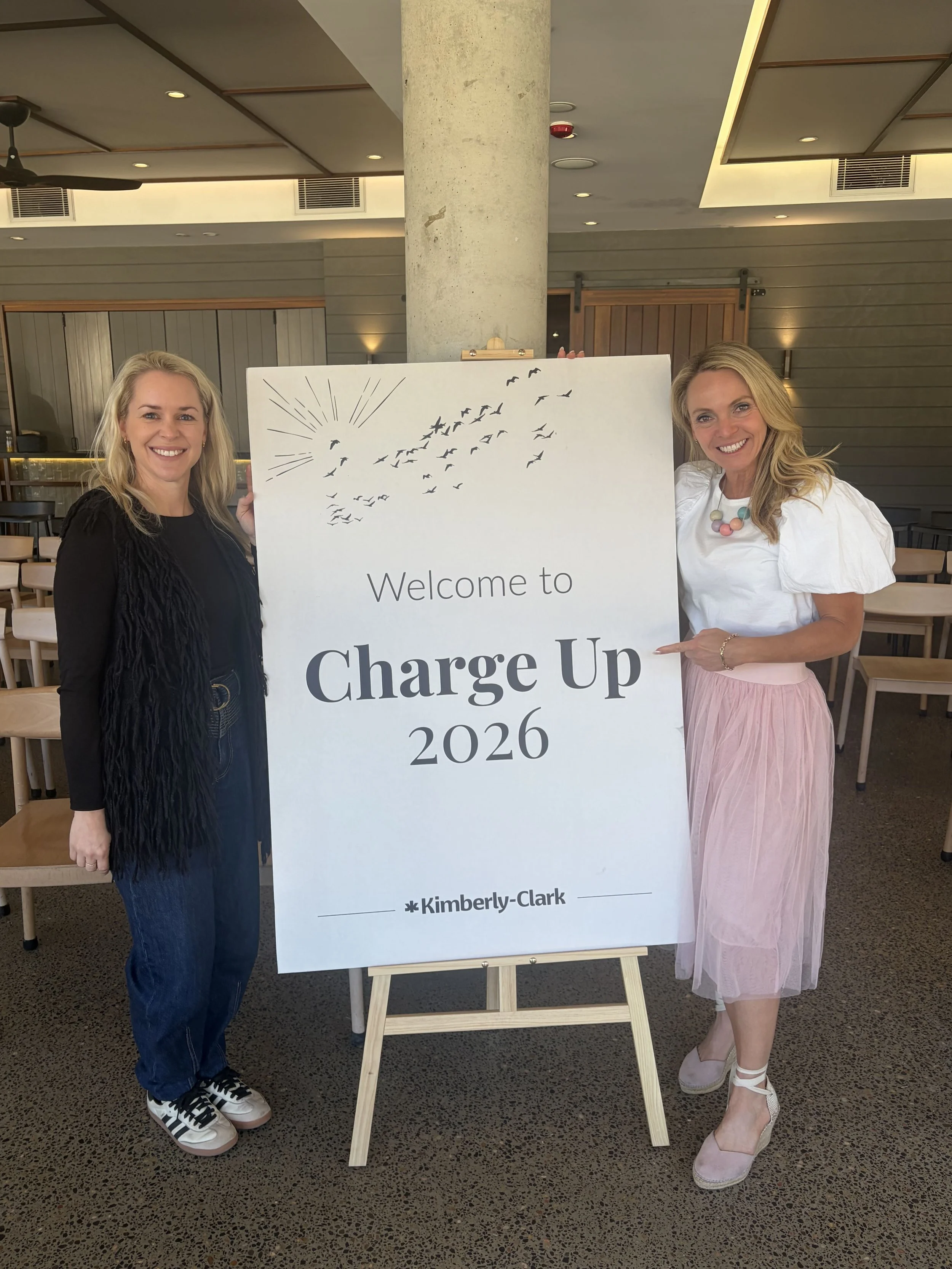
I've just spent two days in the bush with 200 people from Kimberly-Clark ANZ, and I'm still buzzing about it.
Not because of the glamping tents, though they were excellent. Not because of the quad biking, the horse riding, the canoeing or the bushwalking, although they were a blast. It's because I watched a company do something a lot of organisations talk about and very few actually commit to: they took 200 people out of the office, out of Teams meetings, out of the endless scroll of the daily to-do list, and they built two days for their team to genuinely reflect, reconnect and recharge. The theme was Charge Up, and what a perfect theme it was.
I was there to run my Conversations That Count masterclass three times, to rotating groups of about 60, and to close the whole thing out with a keynote on Thriving Through Change the next morning. What I didn't expect was how much the event itself would teach me about the thing I was there to teach them.
Here's some of the things that really stood out to me
On day one, I ran my outdoor sessions in what I can only describe as a bean bag amphitheatre, in the open air, at Glenworth Valley. If you've never tried to facilitate a room while the wind is doing its best to repossess your flipchart and the flies are treating your face like their own personal share house, I probably would not recommend it. At one point a team member went and found planks of wood to weigh down the flipchart, whilst another lent me their jacket to protect me from the arctic wind. I was vey grateful for both. It was at this time thought where I was questioning, is this going to land, or am I about to lose 60 people to the wind and the flies before I've said a word about curiosity over judgement.
It landed. Probably better than it would have inside, if I'm honest. There's something about people sitting on bean bags in the open air, no lanyards, no fluorescent lighting, that gets them talking straighter and listening harder. By the third rotation, I was really letting loose, sharing embarrassing stories of what not to do. Later that afternoon people were coming up telling me which language tip they were already noticing immediately, not next quarter, that afternoon, in a conversation they were having with each other. That's the whole point of the work. Not another framework people nod at and forget. A conversation that actually happens.
Then came the KChella party. Denim and glitter, a food truck, bonfires, fairy lights, a kick-arse DJ, and senior leaders out on the dance floor line dancing like nobody was watching, when in fact everybody was watching, and loving it. I've sat in enough corporate rooms to know how rare it is to see leadership let its guard down that visibly, in front of the whole team, for no reason other than it's a party and they're here celebrate too. That's not a small thing. That's a culture signal, and the team read it loud and clear.
The next morning was the real proof. A 9am keynote, the morning after a party, and I fully expected a room half full of people nursing their choices from the night before. Every seat was taken. That tells you something about a workplace, when people choose to show up for each other even when nobody would blame them for sleeping in.
The leadership panel that followed was the other moment that got me. Real questions from the floor, answered without the usual corporate hedge, leaders willing to say I don't know yet, or that's a fair challenge, in front of 200 of their own people. In a period of genuine change and uncertainty for this business, that kind of openness is worth more than any slide deck on strategy or values.
Why this matters, beyond the fun of it
There's a reason I do this work. Teams don't build trust in a meeting. They build it in the moments either side of the agenda. A shared bean bag, a borrowed jacket, a leader dancing in double denim, a panel that doesn't dodge the hard questions. My mantra is “difficult conversations often happen because better conversations didn’t”.
These are the moments where those better conversations are happening. These are the moments that make the harder conversations, the ones about change, about performance, about what's not working, actually possible six months from now, because the trust was already banked.
Kimberly-Clark didn't just run a brilliant conference. They invested in their people, deliberately and visibly, at a time when it would have been easy to justify not doing it. I left feeling more invested in this team than I have in a long time. And if I feel that, having only spent two days with them, I can only imagine how invested the 200 people who work there every day are feeling right now.
That's the whole business case for bringing your team together, if you need one written down. It's not the bonfire. It's what the bonfire makes possible afterwards.
If you're thinking about bringing your team together to celebrate 2026 and reset for 2027, there are only a few months of 2026 left to make it happen. I'd love to help you do it. Let’s chat.
We had the pleasure of having Blythe facilitate some “Conversations that Count” development sessions at our annual conference, as well as deliver a keynote presentation on our final conference day. As an organisation that has experienced significant change and will continue to navigate transformation over the coming years, Blythe struck exactly the right balance between engaging, thought-provoking content and practical, actionable takeaways.
Blythe’s authentic, warm, and relatable style resonated deeply with our people. Her powerful storytelling, openness, and vulnerability captured the audience from start to finish, leaving participants feeling energised, inspired, and equipped with new perspectives. The buzz following her sessions was a testament to the impact she had.
If you have the opportunity to work with Blythe, I cannot recommend her highly enough.
Diana Brandt, Head of People & Culture IPC ANZ, Kimberly-Clark
Comments