What a 21-Year-Old in ICU Reminded Me About Language and Leadership
My niece Charlotte has been seriously ill in the University of Michigan hospital, where she spent 103 days, her 21-year-old liver and lungs going into complete failure.
I had the privilege of spending 2.5 weeks by her bedside during some of the darkest days.
Every morning we didn't know what we were going to find. It was a rollercoaster, just not a fun one.
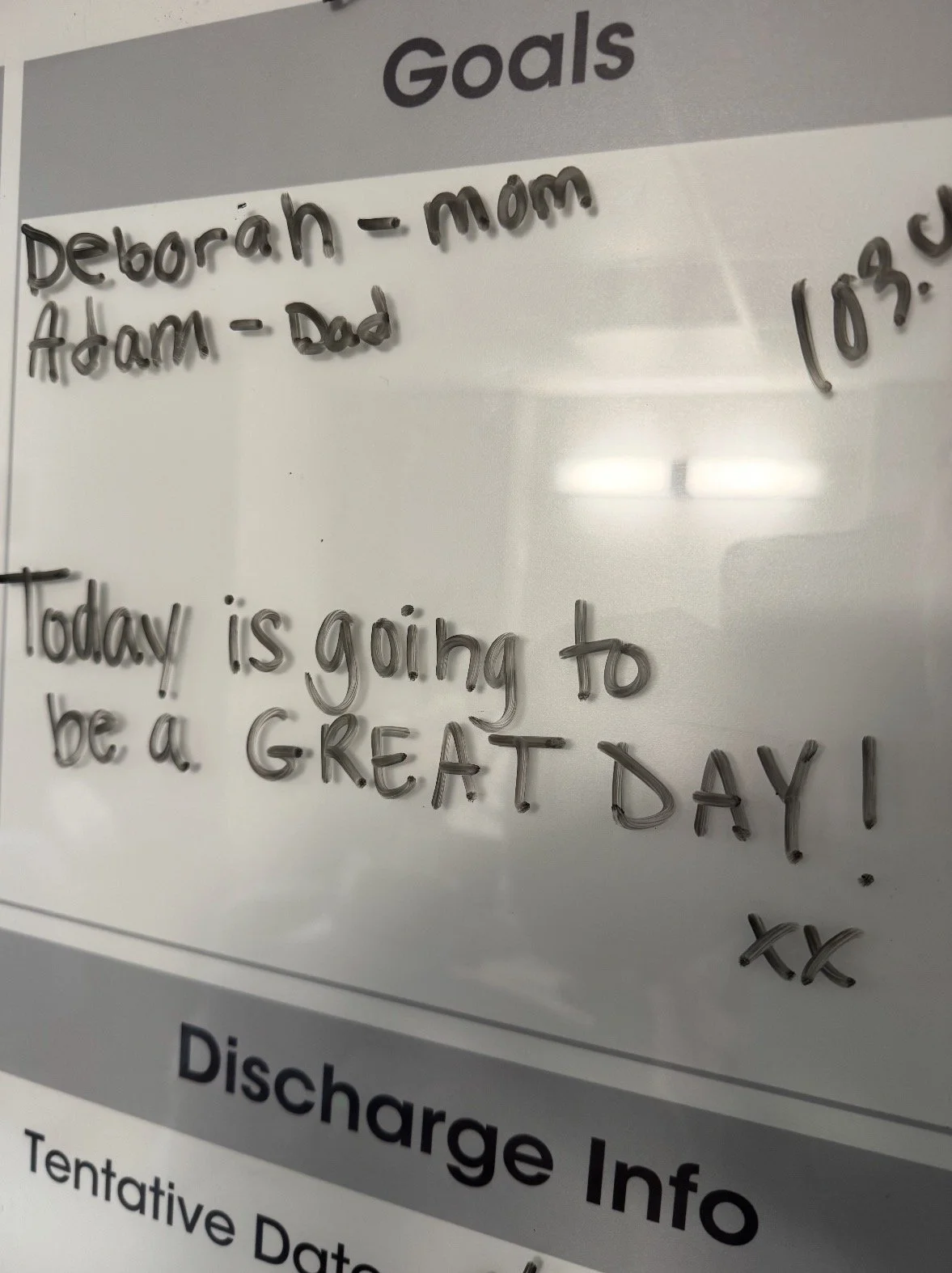
Jami, Charlotte's respiratory therapist and angel 😇 on earth, had a daily ritual. Every single morning, before anything else, she would walk into the room, kiss Charlotte on the forehead and write on the whiteboard:
"Today is going to be a GREAT DAY!"
Not because it was. Not because the day ahead was going to be easy. But because Jami knows the power in choosing to decide, before the day had a chance to write its own story.
Over time, something shifted. Small wins started to accumulate. The kind of milestones that only make sense if you've sat in an ICU room for months on end. Three ice chips every hour to enjoy. Hair being braided. A visit from a therapy dog. And every time one of those moments arrived, the words on the board levelled up. "Today is going to be an incredible day."
Then Charlotte's beloved NRL team, the Canterbury Bulldogs, had a win.
They hadn't exactly set the season alight. But on a particular day, they won. Charlotte and my brother Adam had been up early watching the game, and later that morning Matt Burton sent Charlotte a video message from him and the boys, dedicating the win to her.
I arrived at the hospital not long after to find Charlotte writing in her journal. She noted the Bulldogs' victory. She noted an IV drip had been removed from her arm. She noted she was allowed to move from the bed to the chair for an hour. Small things that, stacked together, meant everything.
She ended her journal entry with: "Today is going to be an awesome day."
She had taken the ritual off the whiteboard and made it her own.
Whilst fighting for her life, she found the joy and awesomeness in the smallest of things. This is not just a beautiful story. This is neuroscience.
Dr Daniel Amen, clinical neuroscientist and founder of Amen Clinics, has spent decades studying how language shapes brain function through over 250,000 brain scans. He coined the concept of ANTs, Automatic Negative Thoughts, the habitual, unconscious language patterns that run in the background and quietly determine what we notice, what we expect, and how we perform. His research shows that negative thought patterns actively reduce function in the parts of the brain responsible for judgment, planning and self-control. The language running in your head is not decoration. It is instruction.
Then there is the Reticular Activating System (RAS) 🧠 the Bouncer of the Brain. It's the part of your brainstem that acts as a filter, deciding what information is important enough to reach your conscious awareness. It works on what you prime it with. Tell your brain today is going to be a terrible day, and it will spend the day filtering in evidence to prove you right - the red traffic lights you keep getting, the rude person at the cafe, the friend who has not texted you back. Prime your brain that it’s going to be an awesome day, and it will find evidence to match that belief.
Charlotte's journal was proof that her brain was doing exactly what it had been trained to do. At this point, she could not eat, talk or walk. She relied on oxygen and had tubes coming out of everywhere. Yet her brain was finding the little wins, allowing her to experience those ordinarily horrific days as a new version of "great" and even "awesome."
What does this mean for you and your team?
The words we use consistently, especially at the start of a day, with ourselves, our family and with the people we lead, are a filter. They determine what the Bouncer lets through. What gets noticed and what gets missed.
It doesn't have to be written on a whiteboard. It can be as simple as saying to yourself each morning, "Today is going to be a great day," or opening your next team meeting with: "What's one thing that's gone well this week?"
You are not just being positive. You are training your brain, and your team's brains, to scan for progress rather than problems.
That is not motivational rah rah. That is leadership.
What this experience taught me
Jami never pretended the hard days weren't hard. In fact, she was the bearer of some of the hardest news during those 103 days in ICU. She just refused to let the hard days set the tone before the day had even started. And somewhere in the middle of the most challenging experience of her life, Charlotte picked that up and ran with it.
She no longer needed the mantra on the board. She had internalised the habit.
That is the power of language practised consistently. It does not just change how you feel. It changes what your brain sees, what it filters in, and ultimately what becomes possible.
This is what I talk about when I say language is a leadership tool. It starts with you, before the day starts.
Language matters.
What's the one phrase or ritual that sets your day up? Drop it in the comments.