Here's what we get wrong about bystander intervention: we think it's a character issue.
Here's what we get wrong about bystander intervention: we think it's a character issue.
We assume the people who speak up are braver, more confident, and naturally assertive. We tell ourselves stories about why we didn't act: I'm not confrontational by nature. I'm not senior enough. I didn't want to make things awkward.
And then we carry the guilt, convinced our silence reveals something fundamental about who we are.
But here's the truth that changes everything:
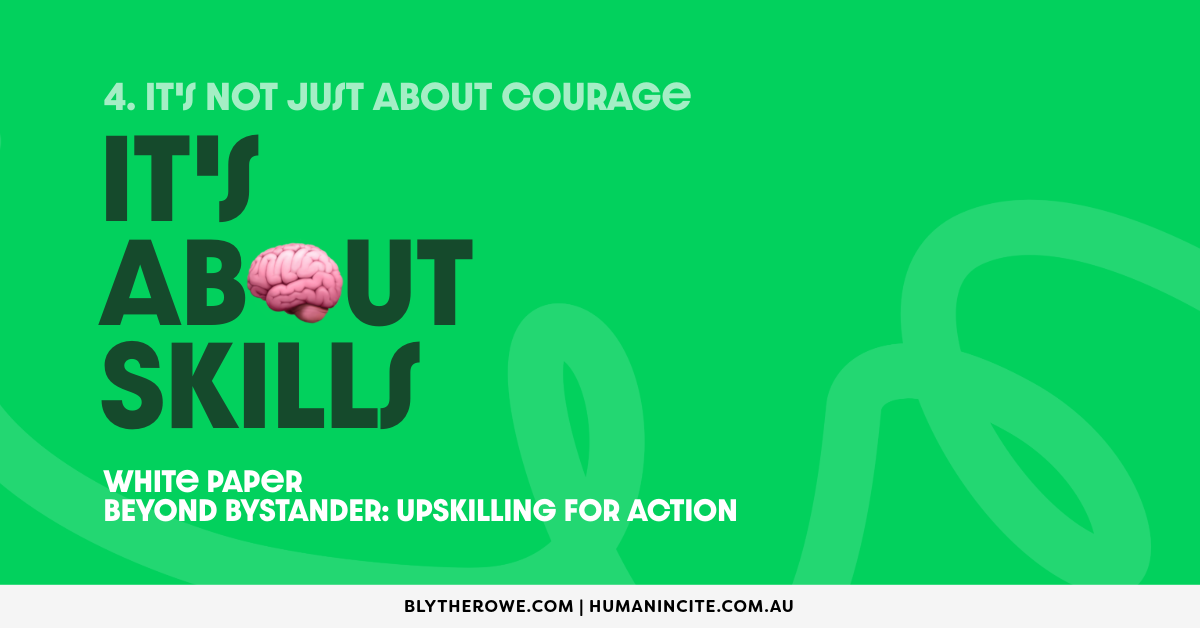
Intervention isn't just about having courage. It's about having skills. 💯
Why "Just Speak Up" Doesn't Work 🤯
Think about the last time you witnessed something inappropriate at work. Maybe you knew you should say something. Maybe you even wanted to.
But in that moment, what actually ran through your mind?
What exactly would I say? What if I make it worse? What if everyone turns on me? What if I'm misreading the situation?
Your brain, flooded with stress hormones, couldn't access the words. The moment passed. The opportunity vanished.
This isn't a failure of character. This is a predictable neurological response to an unfamiliar, high-stakes situation.
We don't expect people to perform CPR without training just because they're "good people who care." We don't hand someone a defibrillator and say "just be brave." We recognise that emergency response requires specific, practised skills.
Bystander intervention is no different.
The Skill Gap Nobody Talks About 🤔
Research shows that in organisations where bystanders receive no training, intervention rates hover around 20-30%. But when people are trained in practical intervention strategies, that rate jumps to 60-70% Safe Work Australia.
Read that again. Training more than doubles the likelihood that someone will act.
The gap isn't simply a lack of courage. The gap is a lack of capability!
Most of us have never been taught:
How to interrupt problematic behaviour in the moment
What to say when rank dynamics complicate things
How to support someone being targeted without making it worse
How to match our intervention approach to the context
How to practice these responses so they're accessible under stress
We're expected to navigate complex interpersonal dynamics, power structures, and split-second decisions with zero preparation. And then we blame ourselves when we freeze.
What Prevents Action (And It's Not What You Think) 💭
When we ask people why they didn't intervene, we hear:
"I didn't know what to say" "I was worried I'd make things worse" "I wasn't sure if it was serious enough" "I thought someone more senior should handle it" "I was afraid of the consequences"
Notice what's missing? "I didn't care" or "I thought the behaviour was fine."
Most people want to act. They're stopped not by apathy but by fear, uncertainty and lack of know-how (skills) to act effectively.
These are all addressable through training.
Reframing the Question 🙋🏻
So the question isn't: Am I brave enough to speak up?
The question is: Have I been trained to intervene effectively? Do I have the confidence and competence to act?
And if the answer is no, that's not a personal failing. That's a gap in capability.
The Bottom Line ✅
You don't need to be naturally confident to be an effective bystander. You don't need to be senior, assertive, or fearless.
You need training. You need practice. You need language, frameworks, and exposure to scenarios until your brain can access intervention strategies even under stress.
The freeze response doesn't disappear. But skilled responses become available alongside it.
There are no bystanders - only people who have been equipped to act, and people who haven't yet. 💯
You want to know more about how Blythe creates meaningful connections? ✨
👉 Check out Blythe’s LinkedIn profile to read more articles and blogs!